The Modern Moat
Table of Contents

TL;DR
Core Idea
AI is making software cheap to build. China’s manufacturing ecosystem made hardware cheap to copy. The next moat is owning a real-world workflow, including the relationships and data behind it. Don’t sell the tool. Run the operation and sell the finished result.
Complete Argument
The defining business moat of the 21st century, pure software, is rapidly collapsing as Generative AI drives the cost of code to zero, mirroring how Chinese industrial agglomeration already destroyed the pure hardware moat. The sheer difficulty of production no longer protects a business in either domain, so durable profit has migrated into the seams between bits and atoms. To build a defensible company today, founders must abandon the generic software vendor model and act as a principal who owns a real physical workflow end to end. By tightly integrating at least three of four key factors (custom hardware, specialized software, earned relationships, and proprietary data), a modern business can deliver a guaranteed outcome while harvesting the closed loop data that becomes the real moat. A competitor starting today is not chasing a fixed lead. They are chasing one that extends every time a job gets done.
. . .
Preface & Purpose
This report expands the one claim everything else in my moat theory rests on: pure software is no longer a defensible moat, and pure hardware stopped being one once China scaled its manufacturing hegemony. Both get thrown around as slogans. I want to take the slogan out and put the mechanism in. Why each collapse happened, which assumptions quietly broke, how the two feed each other, and where durable profit can still be captured. I wrote this to stand on its own, so a future reader, or a future model, can get the whole argument without the conversation that produced it.
For about thirty years, technology strategy assumed the digital world produced durable, high margin, defensible profit while the physical world produced thin, undifferentiated, low margin commodity output. The two shocks did not arrive together. China’s manufacturing agglomeration broke production-based hardware defensibility first, mostly through the 2000s and 2010s. Generative AI is breaking production-based software defensibility later, in the 2020s. Generative AI drove the marginal cost of producing software toward zero, which dissolved the barriers that made software defensible. Chinese industrial agglomeration drove the cost and latency of physical iteration down to the cost and latency of software, which dissolved the barriers that made hardware defensible. So neither bits alone nor atoms alone can shelter a business anymore. Durable advantage moved out of either single dimension and into the tight coupling of both, plus relationships and proprietary data.
The document is in two halves:
- The analysis. What a moat actually is, why each domain used to be defensible, which frictions each shock dissolved, and what is left standing. This half is economic analysis and it stops where analysis stops.
- The modern moat. What defensibility is actually made of now that neither bits nor atoms defend you on their own, and what a company built on it looks like in practice.
The Analysis: How Both Moats Collapsed
Part One: What a Moat Actually Is
Before I explain how the moats collapsed, I need to be exact about what a moat is, because loose use of the word is responsible for most bad strategy thinking I have seen. A moat is not a good product, not a temporary lead, and not the act of being first. A moat is a structural feature of a market that lets a firm earn returns above its cost of capital for a long time without those returns getting competed away. In the language of industrial economics, a moat is a durable source of economic rent.
Economic rent is the surplus a firm earns above the minimum it would accept to stay open, and in a truly competitive market that surplus goes to zero. Under perfect competition, price gets pushed down to marginal cost, firms earn only their cost of capital, and no excess profit survives. Every framework about defensibility is really a theory about how one specific firm escapes that pull toward marginal cost pricing and zero profit.
The classical list comes from Michael Porter, whose five forces framework has been the standard tool for this since 1979, later sharpened by the value investing crowd. It gives a small number of real, durable rent sources:
- Barriers to entry that keep new competitors out
- High switching costs that keep existing customers in
- Network effects, where the product gets more valuable as more people use it
- Economies of scale that let incumbents undercut entrants
- Proprietary IP or regulatory protection that legally excludes imitators
- Control of a scarce input or distribution channel that rivals cannot get to
Every Rent Source Is a Friction
Every one of those rent sources is a friction. A moat is really just a form of friction that competitors cannot cheaply get past:
- High switching costs are friction in the customer’s exit.
- Barriers to entry are friction in the competitor’s arrival.
- Network effects are friction in the coordination it takes for users to move somewhere else together.
- Manufacturing scale is friction in the capital and time an entrant has to sink before it reaches competitive unit cost.
That tells you exactly what something like generative AI, or something like Chinese industrial density, actually does to a market. These forces do not attack products. They attack frictions. They are friction dissolving technologies. And a friction dissolving technology is, by definition, a moat dissolving technology.
The whole argument compresses into one sentence: software and hardware moats collapsed because the specific frictions that generated their rent were the exact frictions that AI and Chinese agglomeration happened to be unusually good at removing.
Part Two: The Historical Software Moat & Why Bits Printed Money
To understand the collapse, you first have to understand why software was historically the single best business structure capitalism ever found, because the collapse is just the reversal of the things that made it great.
Software had an almost unique cost structure. It combined a high fixed cost to make the first copy with a near zero marginal cost to reproduce and ship every copy after that. Writing the first version of a complex program took a scarce, expensive, slow to train pool of engineers working for months or years. But once it was written, the millionth copy cost basically nothing to make and nothing to deliver. That asymmetry produced enormous operating leverage. Mature horizontal software can post gross margins in the eighty percent range, as Atlassian guided for Q2 FY2025, because revenue scales with users while cost of goods sold barely moves. But that statement is less universal than it used to be as consumption-heavy software like Snowflake ran closer to 67 percent gross margin in FY2025, partly because third party cloud infrastructure sits inside cost of revenue. In economic terms, software behaved like a pure information good, and information goods break the normal relationship between production and cost that governs physical commodities.
But low marginal cost by itself does not create a moat. If anyone can make the good cheaply, low marginal cost gives you ruinous competition, not rent. Software earned rent because the high fixed cost of the first copy worked as a barrier to entry, and because several other frictions stacked on top of it:
- Scarcity of engineering talent. Building nontrivial software needed people who were expensive, hard to hire, and hard to coordinate, so most would be competitors simply could not put the team together to build a credible clone.
- Time. Even a well funded competitor needed many months to reverse engineer, spec, build, test, and ship a rival product, and during those months the incumbent had a temporary monopoly to pile up users, revenue, and more product depth.
- Switching cost. Once a customer moved its data into a system, trained its staff on that interface, and wired the system into everything else through custom integrations, leaving got prohibitively expensive even if something better and cheaper showed up.
- The build versus buy calculation. Because building custom internal software was itself expensive and risky, companies rationally bought standard off the shelf products instead of building their own, which guaranteed a big market for packaged software vendors.
- Network effects and accumulating proprietary data, layered on top of all of it in the best cases.
The Structural Vulnerability
Look at what that list is made of. Only one of those five frictions, network effects, is intrinsic to the demand side of the product. The other four, talent scarcity, build time, switching cost, and the build versus buy penalty, are all supply side production frictions. They are artifacts of how hard, slow, and expensive software was to make and to replace.
That is the vulnerability. A business whose defensibility rests mostly on how hard the thing is to produce is only defensible for as long as production stays hard. The moment the cost of producing and replacing software collapses, four of the five pillars collapse with it, and only the demand side network effect is left standing.
That collapse is exactly what generative AI delivered.
Part Three: The AI Shock & the Dissolution of the Software Moat
The right way to model what generative AI did to software economics is to treat it as a shock to the production function of software. In basic economics, the cost of producing anything is a function of the cost of its inputs. For software, the dominant input has always been skilled human cognitive labor, specifically the labor of turning a business requirement into correct, tested, deployable code. That labor was the scarce, expensive input that created the barrier to entry.
Generative AI and autonomous coding agents attack that input directly. They generate, refactor, debug, document, and deploy code at a fraction of the historical cost on many tasks. A controlled GitHub Copilot experiment found developers completed a bounded coding task 55.8 percent faster, and a field study across 4,867 developers found 26.08 percent more tasks completed. The effect is real, but uneven, as a 2025 randomized trial by METR found experienced open source developers working in familiar mature codebases were 19 percent slower with early-2025 AI tools, while believing they were faster. The safe conclusion is not that AI makes every engineer faster in every setting. It is that AI compresses the cost of producing code, especially for bounded, greenfield, and less senior work. The scarce input is being made more abundant. When the price of the critical scarce input falls, the barrier to entry that was built on that scarcity collapses with it. That one mechanism cascades through all four supply side pillars.
The change is visible in the tools developers actually use. First came IDE-native copilots like Cursor. Then came terminal-native coding agents like Claude Code, Codex CLI, Kiro CLI, and OpenCode, where the model reads the repo, edits files, runs commands, and iterates against the same environment as the engineer. Now a third layer is emerging around multi-agent orchestration, with tools like Conductor, Superset, and Hermes Agent coordinating several agents across projects and environments. The progression is clear. It has moved from autocomplete, to autonomous agents, to orchestrating many agents in parallel, and this will only accelerate. Digital work will get easier to automate every year, and the tools that today require a skilled operator will tomorrow require less and less human intervention.
1. The Collapse of the Barrier to Entry
Launching a credible software product used to require real seed capital, most of which went to hiring the engineers needed to build an MVP. That capital requirement filtered the market. Only ventures that could raise money and recruit talent ever shipped, and the resulting shortage of competitors was itself part of the incumbent’s protection.
When one developer with good AI tooling can design, build, and launch a polished, working application in a small fraction of the old time and cost, that filter disappears. The market floods with entrants. In competitive terms, the supply curve of software features shifts massively outward, and basic price theory tells you what happens next without any ambiguity. When supply of a substitutable good expands hard against roughly fixed demand, price falls toward marginal cost, and because the marginal cost of software is close to zero, price gets dragged toward zero too. Hyper abundance of software supply is, mechanically, the destruction of software pricing power.
2. The Collapse of Temporal Advantage
This one was probably the most important software moat of all. The whole logic of shipping fast and iterating depended on a launched feature buying its creator months of exclusive lead before anyone could copy it. That lead time was the window where network effects, brand, and customers got established.
AI compresses the imitation cycle from months to hours. A competitor can watch a product’s interface, describe its behavior to a coding agent, and get a working clone almost immediately, without ever seeing the original source code, because the value was never really in the specific code. It was in the specification, and specifications are now trivially cheap to implement.
When the imitation lag goes to zero, the temporary monopoly that justified rapid innovation evaporates. Innovation still happens, but it stops earning a durable premium, because the reward for innovating is instantly handed to imitators. This is a textbook case of what David Teece called the appropriability problem in his 1986 paper on profiting from technological innovation. Innovation only pays for itself when the innovator can capture enough of the value it creates before imitation competes it away. AI drives appropriability of pure software innovation toward zero.
3. The Dissolution of Switching Costs
This was the sturdiest of the traditional software moats, because it worked even when a rival product was clearly better. But switching costs were themselves made of frictions, migrating data from one schema to another, rebuilding custom integrations, and retraining staff on an unfamiliar interface. Every one of those is exactly the kind of tedious, pattern based translation work that AI is good at.
AI driven data mapping can ingest, normalize, and migrate a complex database from one system’s structure into another’s quickly and cheaply. Natural language interfaces cut the retraining cost, because users increasingly interact through conversation instead of memorizing a proprietary menu tree, which means the accumulated skill locked into one vendor’s interface no longer functions as a switching penalty.
As the cost of leaving falls, the lifetime value of a captured customer falls with it, customer acquisition cost rises relative to that shrinking lifetime value, and the unit economics of the whole subscription model degrade. A moat built on the customer’s inability to leave dissolves when leaving gets cheap.
4. The Inversion of Build Versus Buy
This one quietly destroys the addressable market itself. Companies bought packaged software because building bespoke internal tools was too expensive, too slow, and too risky to justify for anything except their most differentiated needs. That penalty on building internally is exactly what guaranteed vendors a large market.
When AI agents let internal teams, even non technical ones, generate custom applications tailored to their own workflows, the penalty on building disappears, and the rational choice shifts from buying a generic subscription to generating a private tool that fits perfectly and carries no recurring license.
This does not just make competition among vendors more intense. It shrinks the total addressable market vendors are competing over, because a growing share of software demand gets satisfied internally and never reaches the external market at all. Value migrates from external software vendors into internal operational capability, which is to say it stops being a market and becomes an in house cost efficiency.
This is the same thing I called Internal Software Leverage in my writing, The Barbell of Software Value, seen from the vendor’s side instead of the buyer’s.
The Result & What Does Not Collapse
Put those four mechanisms together and you get the commoditization of pure software. The industry is entering software hyper abundance, where functional applications are cheap to build, instantly cloneable, and increasingly generated in house on demand. In that condition the code itself stops being a source of rent, exactly the way any good stops commanding rent once it becomes abundant and substitutable. Value decouples from the code.
Being honest requires saying clearly what does not collapse, because overstating this would make it wrong. Generative AI attacks supply side production frictions. By itself, it does not attack demand side and system level frictions.
- Network effects survive, because AI can clone a social network’s software in an afternoon but it cannot clone the users, and the users are the asset.
- Proprietary data moats survive and actually get stronger, because AI makes code cheaper to produce while making the rare data that trains it more valuable.
- Distribution and brand survive, because attention and trust stay scarce even when features are free.
- Regulatory and compliance barriers survive, because a coding agent cannot generate a banking license, a medical device clearance, or an aviation certification.
- Deep integration into physical or regulated operational reality survives, because code is cheap, but installing sensors, earning trust, and operating under regulatory approval are not.
So the precise claim is not that all software businesses die. It is that the specific, once dominant moat of pure, standalone, packaged software, defended by the difficulty of writing and replacing code, has been destroyed. What survives is software anchored to something AI cannot cheaply reproduce: a network, a dataset, a regulatory position, a distribution channel, or a physical operation. Software that floats free of all of those is now a commodity.
Part Four: The Historical Hardware Moat & Why Atoms Were Hard
The hardware argument takes the same discipline. First establish why hardware used to be defensible, then show which of those defenses China’s manufacturing system dissolved.
Hardware was defensible for almost the opposite reasons software was, and capital markets treated the two as opposites. Where software had near zero marginal cost, hardware had high and stubborn marginal cost, because every physical unit ate materials, energy, labor, and machine time. Where software shipped instantly and infinitely, hardware was bound by the physics of manufacturing and logistics. Those properties made hardware a worse business on margin, but they also, strangely, made it defensible in a specific way, because the difficulty of physical production acted as a barrier that protected a well run hardware firm from casual imitation.
The specific frictions that protected hardware were these:
-
Tooling capital. Making a physical product at scale required specialized tooling, mainly the injection molds and casting dies used to form plastic and metal parts, and those tools cost tens or hundreds of thousands of dollars and forced high minimum order quantities. That was a hard capital wall most entrants could not climb, and it protected incumbents who had already amortized their tooling.
-
Iteration latency. Refining a physical design meant cutting new tooling, adjusting tolerances, and running physical test batches, a loop that took weeks or months per turn and cost heavily every time, so physical products improved slowly and a competitor needed a long expensive campaign to catch up.
-
Supply chain assembly. A physical product is a bill of materials sourced from many specialized suppliers, and those suppliers used to be scattered across firms, regions, and countries, so putting together a working supply chain meant negotiating with isolated vendors, eating long lead times, and managing complicated logistics.
-
Precision and process knowledge. The accumulated, often tacit, know how it takes to actually manufacture a design at acceptable yield. It does not transfer from a drawing. You have to learn it by doing.
-
Distribution. The need to get physical product in front of buyers through retailers, distributors, and shelf space that were themselves scarce and gatekept.
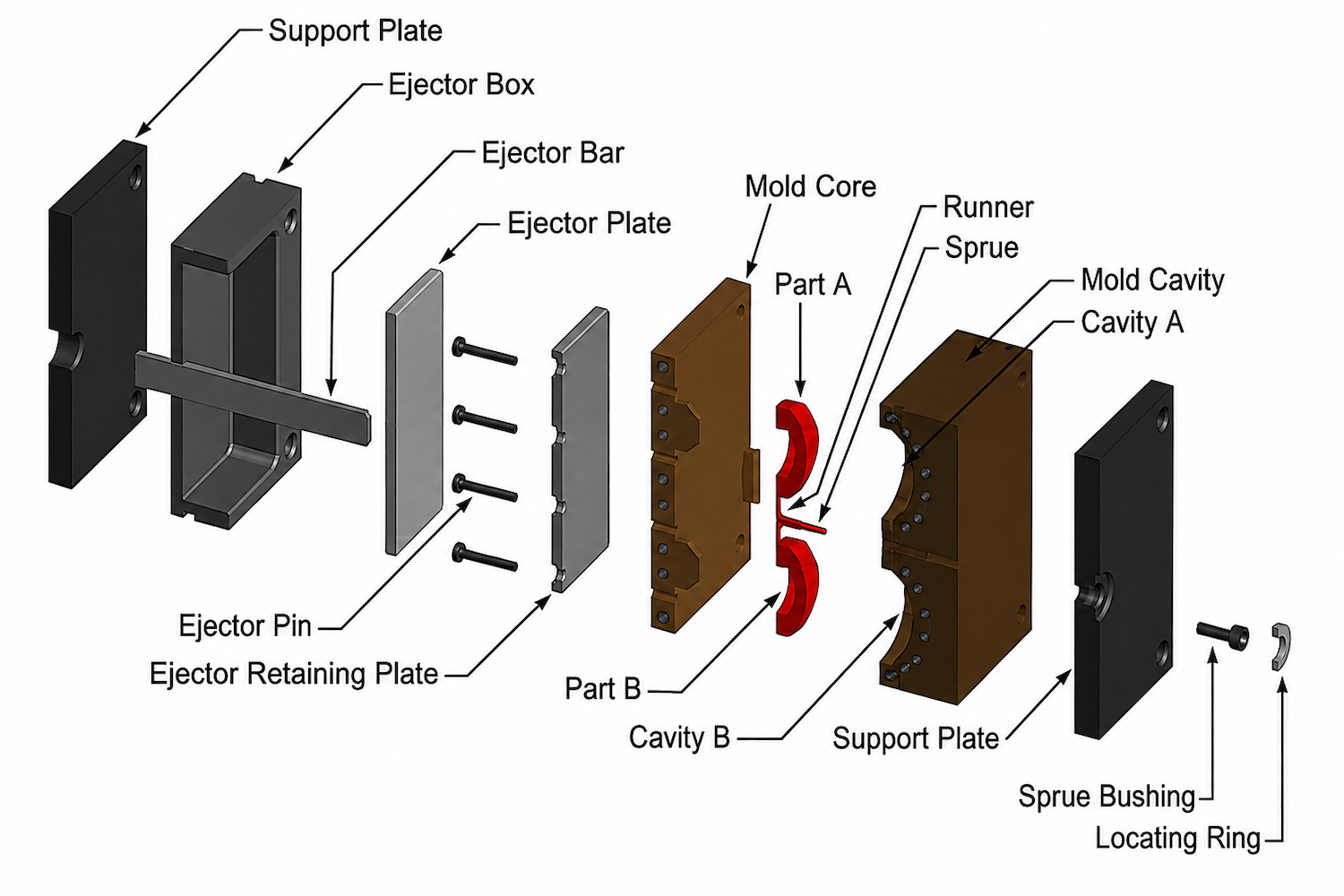
Look at the composition again, same as with software. The hardware moat was overwhelmingly a set of production and logistics frictions: tooling capital, iteration latency, supply chain assembly, process yield, and physical distribution. It was defended by how hard, slow, and expensive it was to turn a design into a shipped physical object. And exactly like software, a defense built on the difficulty of production is only durable while production stays difficult.
But China’s contribution to economic history was making physical production, across an enormous range of goods, no longer difficult.
Part Five: The China Shock, Industrial Agglomeration, & the End of the Hardware Moat
The most common misunderstanding of Chinese manufacturing dominance is that it is a story about cheap labor. That was partly true in the first phase and is mostly false now, and getting it wrong leads straight to the failed conclusion that reshoring, or moving production to the next low wage country, will restore the old order.
The real explanation is that China built, at density and scale nobody had seen before, the phenomenon Alfred Marshall described over a century ago as industrial agglomeration. That agglomeration, not wage arbitrage, is what took the hardware moat apart. I am not the first to make this argument. Andrew “bunnie” Huang has documented the Shenzhen version of it first hand for over a decade in The Hardware Hacker.
Marshallian External Economies
Industrial agglomeration is the self reinforcing geographic clustering of connected industries, component suppliers, subassembly makers, raw material processors, toolmakers, contract manufacturers, logistics providers, and specialized skilled labor, all packed into the same region. Marshall identified why those clusters generate advantages no isolated firm can match:
- They create a deep shared labor pool of specialized workers.
- They support specialized local suppliers who could never survive serving one distant customer but thrive serving a dense cluster of them.
- They generate knowledge spillovers, where process improvements spread fast through the cluster because the relevant people are physically close and move around.
Those three forces are the Marshallian external economies, and they mean a firm inside the cluster gets lower costs, faster iteration, and better information than an identical firm outside it, no matter how efficient that outside firm is on its own.
Transaction Costs Collapse
In the Pearl River Delta, and Shenzhen in particular, agglomeration hit a density with no historical precedent. The practical consequence is easiest to see through the transaction cost economics of Ronald Coase. Coase explained that the boundary and speed of economic activity are governed by transaction costs, the cost of searching for suppliers, negotiating terms, and coordinating production across firms. In a spread out supply chain those costs are enormous, and they are the real content of the hardware moat’s third friction.
In a hyper dense cluster, transaction costs collapse to almost nothing. The entire supply chain for most electronic and mechanical devices sits inside a small radius, so searching, sourcing, negotiating, and coordinating that used to take weeks across continents now takes hours across a district. A designer can spec a device, source every component locally the same day, get a custom circuit board fabricated and populated overnight, and hold a working prototype the next morning.
This is not cheaper labor. It is the near elimination of transaction cost and iteration latency, which is a categorically different and far more powerful thing.
Out of that density, four mechanisms dissolved the hardware moat, mirroring the four AI applied to software.


1. The Collapse of Iteration Latency
This is the hardware version of software losing its temporal advantage. In the dispersed Western supply chain a physical design turn took weeks and cost a lot, so hardware improved slowly and the incumbent’s refinement lead held. Inside the cluster, physical iteration approaches the speed of software iteration. Molds get modified, board layouts get adjusted, and test batches get run in days.
The strategic consequence is brutal. Any hardware design conceived in the West can be observed, reverse engineered, optimized for manufacturability, and mass produced inside the cluster faster than the originating Western firm can finish its own second prototype. The originator’s lead time, which was the source of its rent, is negative. The imitator ships the improved, cheaper version first.
2. The Collapse of Tooling Capital
This is the hardware version of software’s barrier to entry falling. The tens of thousands of dollars and high minimum order quantities that used to wall off physical production have been optimized away inside the cluster through fast computer controlled machining, standardized modular mold bases that get reconfigured instead of cut from scratch, and viciously competitive high throughput tooling shops. Small batch, highly customized hardware can now be produced at a cost structure that used to be available only to large multinationals. The capital wall that filtered hardware entrants has largely fallen, same as the one that filtered software entrants, and the market floods with the same predictable downward pressure on price.
3. The Experience Curve, Compounded by Automation
This mechanism is what locks the cost lead in permanently, and it is the reason the advantage cannot be arbitraged away by moving somewhere else. Wright’s Law, first described by Theodore Wright in 1936 from aircraft production data and later generalized by the Boston Consulting Group as the experience curve, is one of the most reliable empirical regularities in industrial economics. It states that for many products, unit cost falls by a consistent percentage every time cumulative production volume doubles, because the organization learns, through accumulated doing, how to manufacture more efficiently.
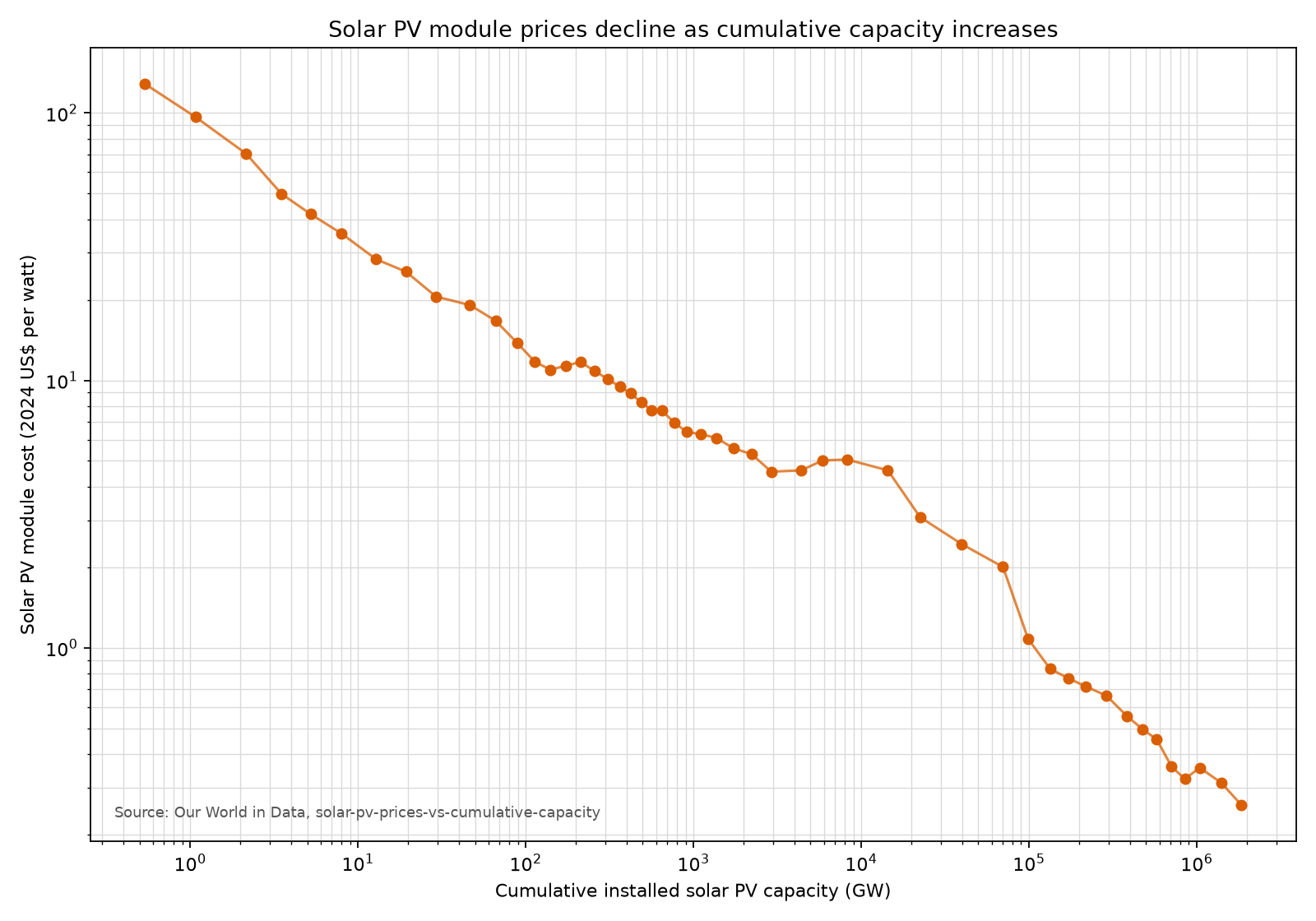
Because the cluster produces an overwhelming share of global cumulative volume across countless product categories, it sits far down the experience curve that any new entrant, at low cumulative volume, sits at the top of. Modern Chinese manufacturing then compounds that learning advantage with capital intensive automation, advanced robotics, high speed automated optical inspection, and vertical integration reaching all the way back into raw materials.
This is the exact point where the labor cost explanation dies. The modern advantage is not low wages. It is accumulated learning plus automated scale plus supplier density, and a newcomer cannot replicate that combination with any short term action, high wage or low wage, because you cannot instantly buy decades of cumulative production experience or the supplier ecosystem around it.
4. The Collapse of the Distribution Friction
This is the hardware version of AI eroding the need to go through incumbent software channels. Global digital marketplaces and hyper efficient parcel logistics let manufacturers inside the cluster skip Western distributors, wholesalers, and retail shelf space entirely, listing directly on global platforms and shipping to a consumer’s door in days. The last friction protecting an incumbent hardware brand, its control of shelves and channels, gets bypassed. A functionally equivalent device reaches the same customer at a fraction of the branded price without ever touching the incumbent’s distribution system.
The Industrial Commons & Why Reshoring Is So Hard
The most important consequence of all this, and the one most often ignored, is about reshoring, and this is where the idea of the industrial commons matters. Gary Pisano and Willy Shih named this in Restoring American Competitiveness (PDF) in 2009. Their observation was that manufacturing capability is not a property of individual firms. It is a property of an ecosystem, a shared local base of suppliers, toolmakers, process engineers, and tacit know how.
When a country offshores production, it does not just lose factories. Over time it loses the surrounding commons, because the suppliers, toolmakers, and skilled process engineers atrophy or relocate once there is no local demand keeping them alive. Once the commons is gone, no single firm or subsidy can rebuild it quickly, because a lone reshored factory has no local suppliers, no local toolmakers, no local pool of experienced process engineers, and therefore none of the Marshallian external economies that made the cluster efficient in the first place.
That is why reshoring a commoditized hardware category is so hard and so expensive. The advantage the reshorer is trying to recreate was never inside the factory. It was in the ecosystem around the factory, and that ecosystem is not at home anymore. The moat did not move to China because Chinese firms are individually better. It moved because the commons moved, and a commons is a collective asset that individual action cannot rebuild.
The macro conclusion for hardware parallels the one for software exactly. The moment a physical product’s specs are known, the hyper dense manufacturing ecosystem can replicate it, optimize it for manufacture, and distribute it directly at a cost structure that annihilates the originator’s margin. Standalone hardware, defended only by the difficulty of physical production, has been commoditized, because that difficulty, for a vast range of goods, no longer exists.
Part Six: The Sequential Collapse & Its Strategic Consequences
People usually analyze the two collapses separately, and chronologically they should. The hardware collapse came first. Chinese agglomeration made production-based hardware defensibility weak across consumer electronics and many mid-complexity goods years before generative AI coding tools mattered. The software collapse came later. The actual event for a founder today is not that they started together. It is that both conditions are now present in the market.
Earlier eras still offered an escape route. When software got competitive, capital could run toward defensible hardware. When hardware got competitive, capital could run toward defensible software. The two domains were alternating shelters. That rotation no longer works. Pure atoms already lost their production moat, and pure bits are now losing theirs. There is no pure bits refuge and no pure atoms refuge anymore. This is the deeper meaning of the barbell I wrote about last year. The middle, where a firm relied on one dimension being hard, has been hollowed out from both sides.
First Order Consequence: Generalized Deflationary Pressure
When the marginal cost of software approaches zero and the effective cost of physical replication approaches the cluster’s hyper efficient floor, competition pushes prices in both domains down toward those floors. That is disinflationary for consumers and destructive for producers with no moat, and it explains a puzzle a lot of people notice, that enormous technological progress sits right next to compressing margins for the firms actually doing the producing. Progress is being captured by consumers and by imitators instead of by innovators, precisely because appropriability collapsed in both domains.
Second Order Consequence: Rent Migrates Along the Smiling Curve
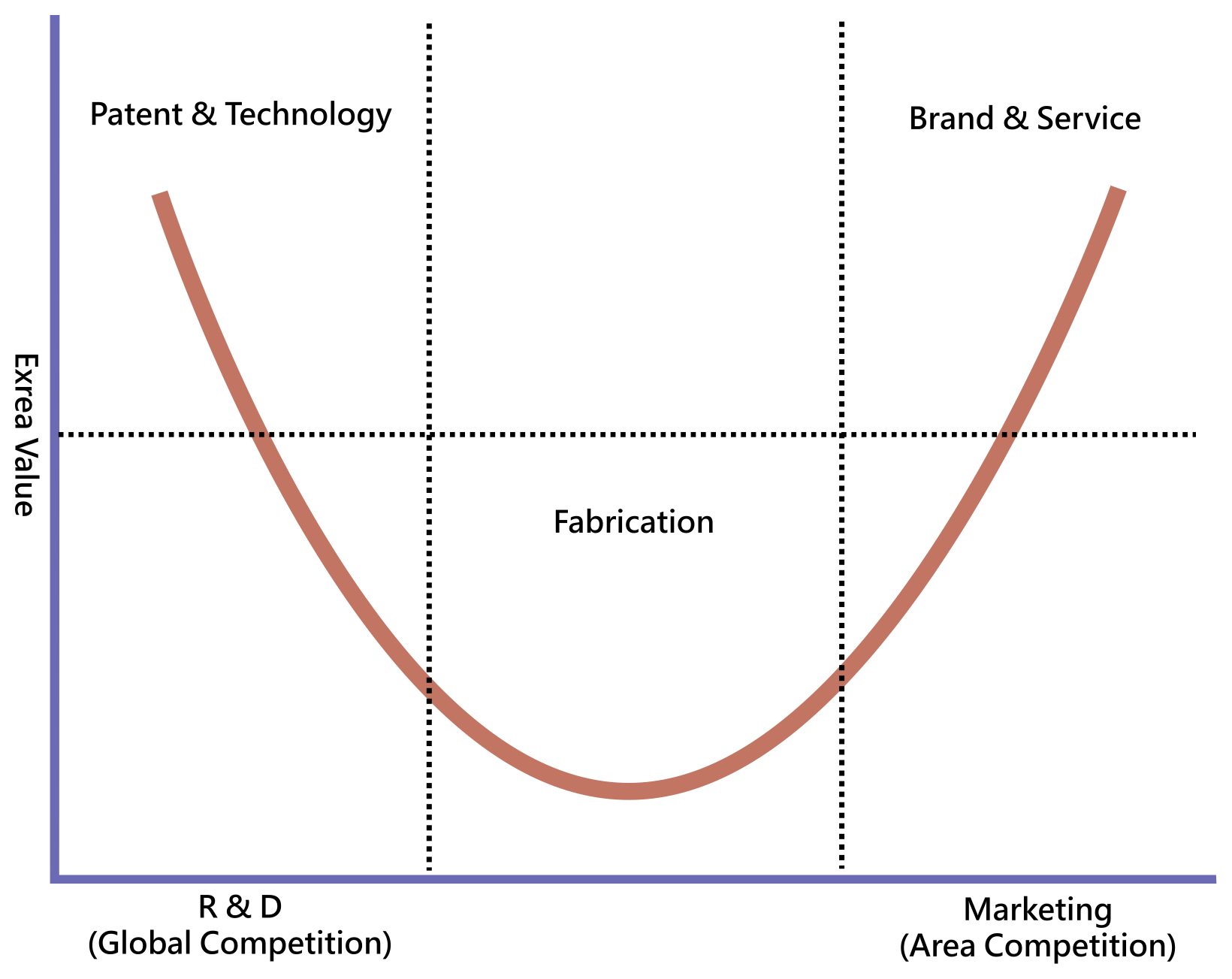
Stan Shih, the founder of Acer, proposed the smiling curve around 1992. Plot value added against the stages of production in a manufacturing value chain and you get a shape like a smile. Ben Thompson has adapted it to publishing, which shows the curve is not really about manufacturing at all. Here is the original:

Shih’s stages are these:
- High value upstream, meaning design, branding, and intellectual property
- A deep trough in the middle, meaning physical assembly and manufacturing, the stage that commoditizes most easily
- High value downstream, meaning distribution, service, and the customer relationship
China’s rise flattened and commoditized the middle of that curve for hardware. Generative AI is now commoditizing the equivalent middle for software, which is the mere act of writing code. The instruction that follows is identical in both cases: abandon the commoditized middle and move to the ends of the smile.
But the ends are exactly the demand side and system level assets that neither AI nor manufacturing density can cheaply replicate. Upstream that means proprietary data, research, and design insight. Downstream that means brand, trust, distribution, regulatory position, and ownership of the customer relationship and the operational outcome.
Third Order Consequence: Rent Moves Into the Seams
This is the consequence that connects the analysis to the strategy. Durable rent has migrated out of any single dimension and into the coupling between dimensions, and into assets that sit outside production altogether. If pure code is free and pure atoms are cheap, then the frictions that still generate rent are the ones living in the seams:
- The tight co-design of custom hardware with custom software, so neither one is useful to an imitator without the other.
- The proprietary data generated by operating a real physical or regulated workflow, which is scarce precisely because it is a byproduct of doing the work rather than something that can be copied.
- The deep, slow to build relationships and regulatory accreditations in conservative industries, where a cheaper clone gets disqualified before anyone even evaluates it.
- The position of principal, where a firm does not sell a commoditizable tool but instead owns the operation, absorbs the liability, guarantees the outcome, and captures both the full profit pool and the exclusive data exhaust.
These are the frictions AI and Chinese agglomeration are structurally unable to dissolve, because they are not production frictions at all. They are frictions of trust, of physical access, of regulation, of accumulated real world observation, and of operational ownership.
Part Seven: Limits, Counterarguments, & Being Honest About Them
A thesis this sweeping has to get pressure tested against its strongest objections, because a strategy built on an overstated premise fails exactly where the premise was too strong.
Objection 1: AI Generated Software Is Not Yet Frontier Grade
The first objection is that AI generated software is not yet equal to expert engineered software for the most complex, highest reliability, or novel systems, and that a real quality frontier still separates commodity generation from frontier engineering.
This is true and it matters. The commoditization argument applies hardest to the large body of conventional application software whose logic is well trodden. At the real frontier, in novel algorithms, in systems that demand extreme reliability or security, and in problems with no precedent in the training data, expert human judgment still commands rent. So the precise claim is that AI collapses the moat for the commoditizable majority of software, not that it abolishes all software value.
But the direction of travel matters strategically, because the frontier that stays defensible is narrow, it moves constantly, and it is a bad foundation for a durable business unless it is anchored to one of the non-production moats above.
Objection 2: Chinese Dominance Is Uneven & Politically Contested
The second objection is that Chinese manufacturing dominance is uneven across categories and now faces serious geopolitical countervailing forces, including tariffs, export controls, national security driven reshoring, and deliberate friend shoring of critical supply chains.
This is true too. The commoditization argument is strongest for consumer electronics, mechanical goods, and mid-complexity assemblies, and weakest at the very top of the technology stack, most obviously advanced semiconductor fabrication, where extreme capital intensity and a handful of irreplaceable suppliers create their own moats. Policy can also artificially put back the frictions agglomeration removed, through tariffs that raise the imitator’s landed cost or export controls that deny it inputs.
But those countervailing forces actually reinforce the central conclusion rather than undermining it, because both the surviving semiconductor moat and the policy driven reshoring moat are, again, not moats of pure hardware. They are moats of extreme capital scale, of irreplaceable supplier position, and of regulatory and geopolitical relationship. They are exactly the non-production, relationship and position frictions this report says rent has migrated toward.
Objection 3: Why Are the Big Incumbents Still So Profitable?
The third objection is the subtle one. If both software and hardware are commoditized, why are the largest technology incumbents still extraordinarily profitable?
The answer is that those incumbents were never actually defended by pure software or pure hardware. Their real moats are network effects, control of distribution and attention, proprietary data at civilizational scale, ecosystem lock in, and in some cases regulatory entrenchment. The collapse described here does not threaten any of that, and in several ways strengthens it, because as pure production gets commoditized, the relative value of the non-production assets the incumbents already own goes up.
This is completely consistent with the thesis. The commoditization of production does not flatten all profit. It redistributes profit away from firms whose only advantage was that production was hard, and toward firms that own the frictions production cannot touch. The incumbents survive because they were never single dimension businesses. That is the lesson, not the exception.
Part Eight: Synthesis & the Bridge to the Modern Moat
The two collapses in this report are, at bottom, the same mechanism repeating in two domains, not one shared timeline. In both cases a class of business earned durable rent because production was hard, slow, and expensive. In both cases a friction dissolving force, generative AI in the digital domain and hyper dense industrial agglomeration in the physical one, made production easy, fast, and cheap. In both cases the rent that was defended by the difficulty of production evaporated the moment production stopped being difficult.
The symmetry is exact, and noticing it is worth more than either half alone, because it exposes the general law under both:
Any moat that consists only of the difficulty of making a thing is temporary, and it lasts exactly until someone figures out how to make that thing easily.
The strategic corollary follows directly. Since neither bits alone nor atoms alone can shelter a business, defensibility has to be assembled out of the frictions that survived both collapses:
- The tight, closed loop integration of custom hardware and custom software, so the system cannot be taken apart and cloned piece by piece.
- The proprietary, continuously refreshed data produced as a byproduct of operating a real workflow, which cannot be copied because it has to be earned through operation.
- The deep relationships, trust, and regulatory standing of conservative industries, which no coding agent and no contract factory can generate.
- The decision to operate as principal rather than vendor, owning the workflow and its outcome so the full profit pool and the entire data exhaust stay captured instead of getting sold off.
A modern venture scale company is defensible to exactly the degree that it assembles several of those surviving frictions into one coupled operating system that gets better as it runs. Everything that used to be a moat because it was hard to build is now a commodity because it is easy to build. What stays defensible is what is hard to access, hard to earn trust into, hard to regulate your way into, and hard to observe without doing the real work.
The future moat is not made of bits, and it is not made of atoms. It is made of the seams between them, and of the relationships and earned data nobody can reproduce without standing where you stand.
Conclusion to the Analysis
The thirty year paradigm that treated software as the reliable engine of defensible profit and hardware as the low margin commodity did not just shift. Its two foundational assumptions were falsified in sequence. Chinese industrial agglomeration falsified the assumption that hardware is hard to iterate and manufacture first. Generative AI is falsifying the assumption that software is hard to produce and replace now.
Because both moats were built mostly on the difficulty of production, and because that difficulty was the specific target of both friction dissolving forces, both moats collapsed. The rent that used to go to whoever could build the bits or forge the atoms now flows to consumers and imitators, unless a firm has anchored itself to a friction that production collapse cannot reach.
Those surviving frictions, integration, proprietary operational data, trusted relationships, regulatory position, and principal ownership of a real workflow, are where durable value went. Building a defensible company in this era means refusing to depend on any single dimension being hard, because nothing that is merely hard to make stays defensible once making it becomes easy.
The Modern Moat
Everything above is diagnosis. It establishes where rent went and why, but it stops at the level of principle, and a principle does not tell you what a company built on it actually looks like. This half is the answer. It covers what defensibility is made of now, and what it looks like assembled into a real business.
The Barbell
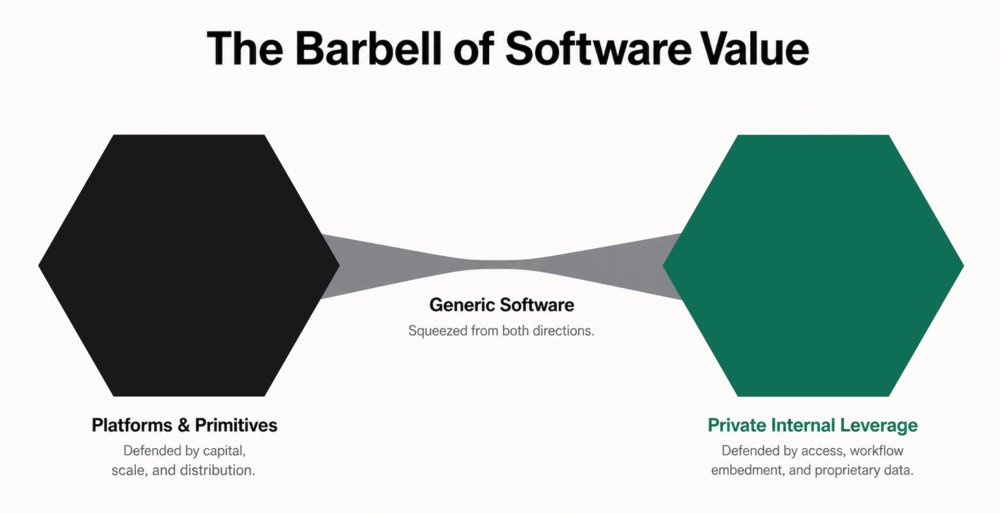
Before the construction rules, it helps to make the barbell explicit, since the analysis kept pointing at it without listing its ends. I laid this out in 2025 in The Barbell of Software Value, where I reconciled my Internal Software Leverage Theory against the abundance thesis. In which the conclusion was that software value is polarizing into two clusters with a collapsing middle.
At one end sit the massive foundational primitives, foundation models, compute infrastructure, cloud platforms, chips, and core AI infrastructure. These are defended by capital intensity, scale economics, and research concentration at a level a new venture basically cannot reach. They are not the opportunity I am describing. They are the environment it operates inside.
Google is the ceiling case. It combines LLM models, TPUs, cloud infrastructure, Search, Android, YouTube, Maps, Chrome, default distribution, and proprietary data at a scale almost nobody can touch. That does not make it a startup pattern. It makes it the upper pole of the barbell fully realized. You cannot start there. What Google proves is the mechanism, that when production gets cheap, durable value migrates into compute, distribution, infrastructure, data, and ecosystem position that a new entrant cannot casually rent its way into. Notice the limit too. Google runs the auction. It does not usually own the advertiser’s outcome. That is why Waymo, not Search, is the cleaner principal-position example later.
At the other end sits highly specific private leverage. Deep workflow ownership, physical world automation, regulatory processes, expert labor replacement, proprietary operational data, and outcome ownership. This end is reachable, and it is defended by exactly the non-production frictions the analysis identified as survivors.
The dangerous middle is generic software. This is the web app, the dashboard, the CRUD tool, the workflow manager, and the thin wrapper over a model API. It gets squeezed from above by the primitives, which keep absorbing general capability into themselves, and from below by the collapse in the cost of building anything generic at all. A product in the middle is easy to build, easy to clone, easy for an incumbent to absorb as a feature, and it usually owns too little of the customer’s value chain to defend a price.
The Four Factor Moat
Defensibility today does not come from one high wall. It comes from interlocking multiple advantages. Four distinct pillars survive the double collapse of hardware and software production. A durable modern company needs a credible path to at least three of them. Not one. Three. Single dimensions do not shelter anyone anymore, and they never will moving forward.
Great Hardware
Great hardware does not mean inventing exotic devices. It definitely does not mean selling a clever gadget at a margin. A visible, copyable, separately sold device is exactly what manufacturing clusters destroy fastest. Hardware earns its place when it is not the product, but the instrument. It gives the company privileged physical access to a process no competitor can observe from outside. It senses the physical world, captures proprietary data, executes physical actions, and standardizes the workflow, making the software above it far harder to copy. The test is simple. Could the hardware be lifted out and sold on its own? If it could, it is a gadget and it will get commoditized. If it is meaningless without the software, the data, and the operation around it, then it is doing moat work.
Great Custom Software
Great custom software is not generic SaaS and it is not a nicer interface. It works inside a specific physical or regulatory process, automates decisions that carry real economic weight, coordinates labor or machines, and captures corrections and edge cases as they happen. Notice what makes it defensible. Not the code, which the analysis showed is now cheap, but its dependence on operational access, proprietary data, and deep workflow knowledge a competitor cannot get by cloning an interface. The software is hard to copy because the things it is wired into are hard to reach, not because the software is hard to write.
Great Relationships
Great relationships are among the most durable moats in hard industries. They are completely immune to both the hardware and software commoditization. They include regulatory accreditation, customer trust, distribution access to conservative buyers, and long-term operational partnerships. You see this across sectors like defense, healthcare, construction, and infrastructure. Buyers in those markets never pick a vendor just because the software is slightly better, and in many cases, not even if it is 10x better. They buy based on trust and track record, reliability, liability, compliance, and proof. A cheaper clone usually gets disqualified before anyone evaluates it. Relationships take time, reputation, and a record of real execution. Neither AI agents nor a Shenzhen assembly line can manufacture trust overnight.
Unique Data
Unique data is the most important of the four and the one people get wrong most often. Not all data is valuable, and generic scraped data is close to worthless as a moat now. The data that matters is private, tacit, and expert level, physical and workflow specific, generated from real operations, and full of the edge cases, corrections, and failures that never show up in any public corpus. You cannot buy this kind of data, and you cannot scrape it. It is produced exclusively as a byproduct of running a live operation through a closed loop of four stages:
- Observation
- Decision
- Action
- Outcome
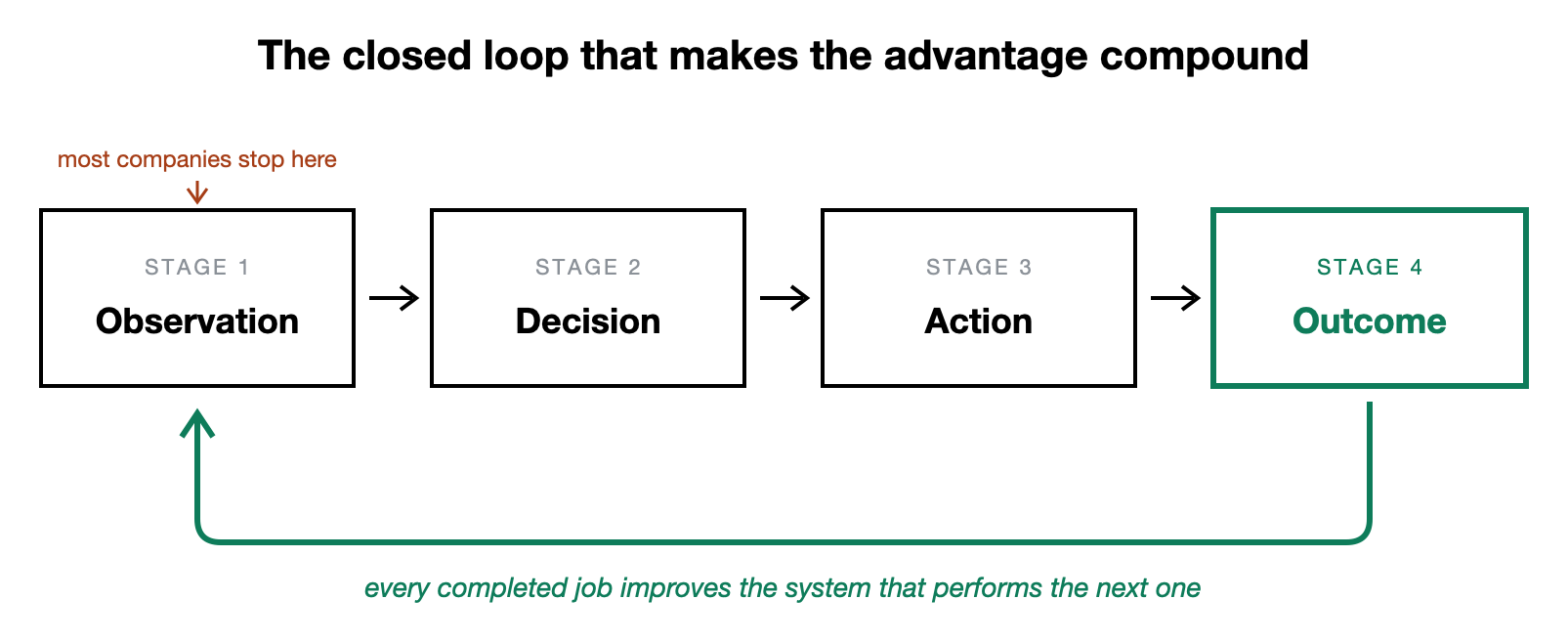
This loop is also where the four factors start reinforcing each other. Hardware observes and acts, software decides and coordinates, relationships give access to the workflow, and unique data compounds from the outcomes.
Most companies capture only the first stage of this data flow. The moat needs all four, meaning you know not just what happened, but what decision got made in response, what action was actually taken, and whether the result worked. That fourth stage, the verified outcome, is what makes the data trainable and what makes the advantage compound. Every completed job improves the system that performs the next job, which is the only form of advantage in this entire document that grows instead of eroding.
When Loops Compound & When They Stall
The closed loop sounds inevitable in the abstract. In practice, most attempts to build one fail. The loop is a claim, not a law, and it has specific failure modes that are more useful to understand than the success case.
-
Data saturates: The value of accumulated data follows a diminishing returns curve. In deep learning, Sun et al. found that performance on vision tasks increased logarithmically with training data volume, which means each doubling of the dataset buys another increment, not another miracle. The first thousand executions teach you the most. The next ten thousand teach less. The next hundred thousand teach almost nothing new. A competitor starting later can often reach 90 percent of your performance with a fraction of the historical data, closing the gap faster than the raw numbers suggest.
-
The data may not be yours to use: You generate proprietary data through the workflow, but if your contract says the customer owns it and you cannot pool it across deployments, you have fifty separate data silos, not one flywheel. At the platform layer, OpenAI, Anthropic, Microsoft Azure OpenAI, AWS Bedrock, and Google Vertex AI all tell business customers their inputs and outputs are not used to train foundation models by default. That is good for customers and a warning for vendors. Cross-customer learning only compounds if the contract allows it. Privacy law adds another constraint, because GDPR purpose limitation, erasure rights, HIPAA de-identification rules, and CCPA/CPRA rules around sharing for cross-context behavioral advertising all make secondary data use harder. This kills more real-world AI moats than competition does.
-
The workflow mutates faster than the model improves: In fast-drifting operational domains, data has a measurable half-life. As Valavi et al. showed in research from Harvard Business School, a large historical stock of data creates a weak barrier to entry. An entrant equipped with a smaller stream of fresh, recent data can often build a more accurate model than an incumbent sitting on years of legacy data, especially when stale data actively degrades accuracy. One clinical informatics study found this directly, where the half-life of inpatient order prediction data was about four months, and one month of recent data outperformed twelve months of older data. In manufacturing, sensor drift, tool wear, process redesigns, and schema changes mean models trained on historical plant data are reasoning about a plant that no longer exists. This is not universal. Physics-governed processes, actuarial tables, geological data, and other slow-moving domains can keep old data valuable for a long time. If the workflow changes faster than the model improves, your historical data becomes stale weight rather than an advantage.
-
The cost is the barrier, and the barrier is the cost: Owning real-world workflows is capital-heavy, labor-heavy, and lower-margin than pure software. Tesla reported total GAAP gross margin around 18 percent in 2025 despite vertical integration. Intuitive Surgical reported a da Vinci installed base of 11,106 systems and non-GAAP gross margin of 67.6 percent in 2025, after decades of capital, surgeon training, and procedure volume. The expense that keeps competitors out also keeps most entrants from building something worth defending. Many attempts fail on unit economics long before the loop compounds.
What separates the loops that actually compound from the ones that are fake moats:
- The data is outcome-linked, meaning you know whether the result was right or wrong rather than just collecting signals.
- The data is contractually yours to use across deployments.
- The workflow is stable enough that historical data stays relevant.
- Each execution generates new edge cases, not more of the same.
- The frequency is high enough for learning to compound before the workflow mutates.
This thesis is wrong if any of the following are true:
- A competitor can acquire equivalent data through scraping, synthetic generation, transfer learning, or a one-time purchase.
- The customer owns the data contractually and you cannot pool it across deployments.
- The workflow mutates faster than the model improves, so accumulated data describes a system that no longer exists.
- Data value saturates within the first N executions, meaning the advantage is fixed, not compounding.
- The cost of owning the workflow exceeds the value of the data it generates.
If those conditions hold, the loop is not a moat. It is an expensive engineering project with a temporary lead. As a16z argued in 2019, most data advantages are scale effects with diminishing returns, not magical network effects. That was true before the current AI wave. It is still true now.
Business Models Built on the Modern Moat
The four factors describe what the moat is made of. The next question is what kind of business model can actually capture it. In practice, the answer points away from selling tools and toward owning the workflow itself.
Principal, Not Vendor
The single highest leverage decision in the whole framework is refusing the vendor position.
A vendor play means selling a tool to the organization that already owns the workflow. It looks attractive because it is capital light and scalable in theory, but it hands every source of leverage to the customer. The operator keeps the customer relationship, the physical process, the operational data, the budget, the liability, and the final outcome. The vendor keeps a layer of software sitting on top of all of it. The startup captures a small fraction of the value it creates, the customer demands custom integrations until the product drifts toward services, the operator can watch the tool work and then replace it with an internal build that is now dramatically cheaper to produce, and because the operator owns the best data, the vendor’s model never compounds. Margins stay capped. This is especially dangerous in physical industries, where software vendors reliably degrade into glorified consultants.
The stronger position is to become the principal, to own the operation, the responsibility, the accreditation, the workflow, or the liability itself. Instead of selling software to whoever performs the work, the company performs the work or guarantees its outcome. That inverts every disadvantage above. The company captures the full margin instead of a licensing slice, owns the customer outcome and therefore the relationship, and owns the data because its own operations generate it. It cannot be disintermediated by the operator because it is the operator, and it builds real operational expertise instead of secondhand understanding.
The principle compresses into one instruction:
Do not sell the tool. Sell the completed result.
In practice this shows up as a consistent reframing of any vendor idea into its principal version:
| Vendor framing | Principal framing |
|---|---|
| Sell inspection software | Become the inspection agency |
| Sell lab workflow software | Own the testing workflow |
| Sell a compliance dashboard | Deliver certified compliance |
| Sell estimation tools | Deliver the estimate |
| Sell predictive maintenance analytics | Prevent the downtime, or own the maintenance outcome |
This decision matters more than any other in the framework, because it decides who owns the data, and data ownership decides whether the advantage compounds or decays.
Service as a Service
The principal position implies a delivery model that looks different from conventional software, and it is worth naming, because at first it looks like a worse business to anyone trained on SaaS margins.
This model has a few names in circulation. YC, a16z, and others have called it service-as-software, and the AI-enabled rollup thesis is a close cousin. I prefer service as a service because it keeps the emphasis on what the customer actually receives.
The customer should not have to use the software to get the job done. The company should use software, AI, human labor, hardware, and operations together to deliver the finished job. The software is internal leverage, not the product.
The sequence is deliberate. Start by doing the work manually, or with humans in the loop. Use software to make that human work faster, more consistent, and more measurable. Capture every input, decision, correction, edge case, and outcome. Then use the accumulated data to automate more and more of the workflow, converging on an automated service provider with margins and defensibility conventional software cannot match.
This differs from consulting in one decisive way. Consulting sells custom labor to each customer forever, and every engagement leaves behind nothing reusable. Service as a service uses early human labor deliberately as the instrument for building the automation system, and every engagement leaves behind data that makes the next one cheaper.
But you have to be careful and look out for a trap in this type of model. If every new customer requires custom integrations, custom data cleaning, custom workflow mapping, and custom model tuning, the company is a consultancy that has not admitted it yet. The human in the loop phase is fine, and often necessary, but only on the condition that it produces proprietary data and converges toward scalable automation. If the humans are still doing the same work at the same cost per unit after fifty jobs, the model has failed.
The Stargate for Data
AI is moving from a compute bottleneck to a data bottleneck. The most valuable AI companies of the coming period will not be the ones with the most generic data, which is abundant and therefore commands no rent, by exactly the logic of the first half. They will be the ones that own rare, private, high quality operational data that cannot be obtained any way other than doing the work.
The phrase Stargate for Data is borrowed from OpenAI’s Stargate, the announced multi-hundred-billion-dollar compute buildout, and the borrowing is the point. If the last cycle’s scarce resource justified planned infrastructure at that scale, the next one deserves the same treatment. The goal is not to accumulate a dataset. It is to build a machine that manufactures proprietary data continuously as a byproduct of delivering a service.
The distinction that matters in this case is that the objective is not to collect data for its own sake, which produces expensive lakes of unusable material. The objective is to own the operational loop that produces exactly the data needed to automate that loop.
The Atoms Computer
The four factors describe a structure. The atoms computer describes what that structure is for, and it is the long term vision that makes the whole exercise worth doing.
I did not come up with this idea and I want to be clear about that up front. The framing is Travis Kalanick’s. After he was pushed out of Uber in 2017 he spent eight years building City Storage Systems in stealth, and in March 2026 he renamed it Atoms and published a vision letter laying the whole thing out. His formulation is that you approach physical world problems the way you would approach software problems, and that the core computing resources have physical analogues where CPU is manufacturing, storage is real estate, and network is transport. At an a16z launch event, Kalanick defined the company around industrial AI, using software, sensors, robotics, and AI to automate operations across entire industrial sectors, starting with food, mining, and transport. Read his letter. It is better than my summary of it, and a few of his conclusions arrive at the same place this document does from a different direction.
As AI gets more capable, its binding constraint is shifting. The limit is no longer just reasoning quality. It is interaction with physical reality. A model can produce text, code, images, and plans of high quality and still be unable to reliably do anything in a messy, unstructured, consequential real world environment. Traditional computers gave intelligence a substrate for manipulating bits. The opportunity now is to build the equivalent substrate for atoms, creating systems that sense the physical world, interpret messy real world conditions, decide, act, verify outcomes, and learn from feedback, all under real physical, regulatory, and economic constraints. That last clause is the hard one, and it is why this is a business opportunity instead of a research project. Operating under regulatory and economic constraint is exactly what cannot be cloned, and it is exactly what generates the closed loop data the fourth factor needs.
On one point Kalanick and I agree completely, and he says it better than I did. His term is gainfully employed robots, meaning specialized machines with a specific productive job, as opposed to humanoids built to imitate us. His example is that if you need to make a thousand pancakes an hour, a humanoid awkwardly flipping them is the worst possible design and a purpose-built machine is the obvious one. So the right approach is not to build a general purpose robot. It is to find a narrow wedge where the sense, decide, act loop can be deployed inside one real workflow with clear immediate economic value, and to make that loop work end to end before widening it.
The near term company should be narrow to the point of looking unambitious. The long term ceiling is the reason to accept that narrowness.
A Worked Example
The framework is abstract, so it helps to walk one idea through it. This is only an illustration of the criteria in use, not the one conclusion the framework forces.
Take construction special inspection and materials testing. The vendor version sells software to the agencies and labs that already own the workflow. The principal version becomes the agency and the lab. It holds the accreditation, conducts the inspections, and carries the regulatory responsibility. Internally, it uses software, hardware, and AI to deliver certified results faster, cheaper, and more reliably than incumbents.
That shape reaches all four factors. It is physical, because it deals in sites, samples, instruments, and real world measurements. It has relationship and regulatory moats, because buyers need results accepted by the authorities having jurisdiction, not a prettier dashboard. It owns the outcome, because it sells certified results instead of tools. And it generates proprietary operational data as a byproduct of the work, including test results, failure modes, material properties, expert corrections, and the links between physical conditions and final outcomes.
It also starts narrow, which follows the classic startup logic Paul Graham and YC have been making for years. Start with a sharp wedge, but make sure the wedge belongs to a large and painful problem. There is no need to automate construction inspection as an industry on day one. The entry point can be one inspection type, one material test, one geography, or one compliance workflow. From there, software standardizes the work, humans produce the first data, and automation expands only where the loop actually compounds.
The risks are exactly the ones the framework predicts. Accreditation timelines gate revenue, operations are heavy before automation matures, and the services trap is real if each project turns out to be bespoke. That is the point of the framework. It does not make the business easy. It tells you where the hard parts should be.
Companies That Already Look Like This
The framework is easier to trust if it describes things that already exist rather than only things I would like to exist.







Anduril is four of four. Custom hardware across drones, sensor towers, interceptors, and undersea vehicles. Custom software in Lattice, which every piece of that hardware runs on. Relationships and regulatory standing no coding agent can generate, since the customer is the US government and its allies. Operational data from deployed systems feeding back into the software. Two details matter more than the product list. It funds its own R&D and builds the product before selling into an existing budget line, inverting the cost-plus model traditional primes run on. Anduril is private and does not publish audited margins, but secondary estimates put its gross margin around 40 to 45 percent. That is unusually high for defense hardware, where aerospace and defense companies average roughly 17.5 percent gross margin in NYU Stern’s sector data. The precise number matters less than the structure. A vertically integrated, fixed-price, software-defined model appears to earn better economics than traditional cost-plus platform integration.
Intuitive Surgical is the older, quieter version of the same structure. The da Vinci system combines hardware that is worthless without its software, FDA clearances no competitor can shortcut, two decades of hospital relationships, and procedure data from millions of operations. It reaches four of four, compounds continuously, and has been executing this playbook since its initial clearance in 2000, long before anyone called it physical AI.
Kraken Robotics is the one I find most instructive, partly because few outside marine technology know it. It builds synthetic aperture sonar, the KATFISH towed platform, subsea batteries, and underwater LiDAR. None of that hardware is useful without the proprietary imaging software wrapped around it. Its customers include NATO-aligned navies. That is trust and regulation at the highest level, because a navy will not switch sonar vendors for a cheaper clone. Crucially, Kraken does not just sell equipment. It runs surveys as a service, meaning every job produces seabed intelligence nobody else holds. That last decision is the whole framework in miniature. A hardware company noticed the data was worth more than the box, and moved into the principal position to keep it.
SpaceX & Waymo are pure principal plays. SpaceX does not sell rockets. It sells delivered payloads. Waymo does not license autonomy software to car companies. It sells completed rides. In both cases, the company refused the vendor position, absorbed operational liability, and kept the data. Waymo also carries a regulatory moat that arrives one jurisdiction at a time. That expansion is slow, which is precisely why it is defensible.
Carbon Robotics is the useful partial case. Its LaserWeeder kills weeds using computer vision and high-powered lasers. In February 2026, the company stated that its Large Plant Model was trained on more than 150 million labeled plants, collected across roughly a hundred farms in fifteen countries. That is the data engine working as described, generated as an operational byproduct rather than a separate initiative. But I would also note the vulnerability with this setup. Carbon sells equipment to farmers, remaining a vendor rather than a principal. It succeeds because the data still flows back to its central model, making the vendor position survivable. If growers ever owned that fleet data, the moat would vanish.
Nokia is both the historical warning and an emerging test case. In 2007, it commanded nearly 50 percent of the global smartphone market with the best hardware, manufacturing scale, and supply chain in mobile phones. It executed on a single dimension better than anyone alive, and it collapsed because it lacked a software platform. Today’s Nokia is attempting the exact multi-factor playbook described here. As Michael Sikand outlines in this video breakdown, the company spent over a decade pivoting away from consumer gadgets to bundle vertically integrated optical silicon, entrenched carrier and defense relationships, and AI-enabled edge compute. Old Nokia proved that isolated hardware is a temporary lead. Well, new Nokia is trying to prove that hardware coupled with institutional trust and software infrastructure creates a lasting moat.
None of these companies look alike on the surface, but they all point to the same lesson. The most durable businesses earned something slow, like an accreditation, a deployed sensor fleet, surgeon trust, naval confidence, regulatory approval, or a decade of operating data. None of them got there just by writing better code, and none of them can be caught by someone who does.
Narrowness Is the Entry Requirement
They also all started small. The companies that win do not begin by trying to own the whole loop, and attempting it is the most common mistake. The loop only compounds if you are deep enough in one workflow to generate outcome-linked data that competitors cannot acquire any other way. Shallow exposure to many workflows produces shallow data that saturates quickly.
The pattern holds across the operators above and beyond them. Anduril started with force protection and counter-drone systems before scaling production and adjacent capabilities. Intuitive Surgical started with specific laparoscopic procedures and built surgeon training and procedure volume over decades before expanding across specialties. SpaceX started with one reusable launch vehicle before expanding into Starlink. Tesla started with a narrow premium EV wedge (the Roadster sports car) and used the fleet for data and manufacturing learning before moving into volume models, energy, and autonomy. Palantir started with specific intelligence workflows for specific agencies before expanding into commercial. In every case, the narrow entry was not a compromise. It was the mechanism that made the loop compound.
The entry point is narrow on purpose. One workflow, one customer type, one data stream that is hard to replicate. You build the loop around that workflow until the data compounds and the relationship deepens, then you expand into adjacent workflows where the same data, the same relationships, and the same operational discipline give you an advantage a new entrant cannot match. Starting broad is how you end up with a pile of data that does not compound. A competitor starting today is not chasing a fixed lead. They are chasing one that extends every time a job gets done, but only if the job is narrow enough, deep enough, and repeated enough that the data actually matters.
Conclusion
The first half of this document established a general law. Any moat consisting only of the difficulty of making a thing is temporary, and it lasts exactly until someone makes that thing easy to make. Chinese industrial agglomeration did this to hardware by collapsing transaction costs and iteration latency inside a hyper dense cluster. Generative AI is doing this to software by collapsing the cost of its scarce input. Hardware collapsed first and software followed later, but for a founder building today, neither shelter is reliable.
The second half turned that law into an answer. If production difficulty does not defend anything anymore, then defensibility has to be assembled out of the frictions production collapse cannot reach. Those include physical access, closed loop operational data, regulatory standing, earned trust, and ownership of the outcome itself. That is why the four factors ask for three of four instead of one, why the principal position matters more than any other single decision, and why the data has to be an operational byproduct instead of a collected asset.
It compresses into one core sentence.
In the AI era, the best companies will not be generic software tools or copyable hardware products. They will be narrow, outcome driven principal businesses that combine software, physical workflows, trusted relationships, and proprietary operational data to automate high value real world work.
For a founder, the question is no longer “what software can I build?” but what valuable real world outcome can I own, perform, measure, and automate?
The strongest opportunities sit where software meets atoms, trust, regulation, and proprietary data. They start with one narrow, painful workflow, using humans where necessary. They capture operational data as a byproduct of the work, automate step by step, and compound into systems that are hard to displace. The advantage is durable precisely because it was earned through physical operation instead of written in code.
The end goal is not to build a product. It is to build an operating company with software like scalability, physical world defensibility, and proprietary data that gets better with every job completed.
Everything that used to be a moat because it was hard to build is becoming a commodity. Building something is easier than ever, and as AI and global supply chains advance, it will only get easier. What stays defensible is what is hard to access, hard to earn trust into, hard to regulate your way into, and hard to observe without doing the real work.
Citations & Sources
I want to be explicit about where the borrowed parts come from, because a lot of this document is me connecting other people’s work rather than inventing anything. The things I would actually claim as my own are the four factor rule, the three of four standard, and the specific argument that the two collapses share the same underlying mechanism even though they happened in sequence. Figures move, so check them before quoting me.
Mine, from earlier writing
- The Barbell of Software Value (2025), where I first laid out the collapsing middle and Internal Software Leverage Theory. The second half here is the operating version of that post.
The atoms computer
- Travis Kalanick, Vision, Unfinished Business, and How AI Will Transform the Physical World, Atoms and a16z, 2026. The atoms-based computer framing, the CPU/storage/network mapping onto manufacturing/real estate/transport, the understand-predict-control loop, industrial AI, and gainfully employed robots are all his. That section is my summary of his idea, not my idea.
- Ben Horowitz and Alex Danco, Travis is Back, a16z, 2026.
The economics
- Atlassian, Q2 FY2025 results, for mature horizontal SaaS gross margins in the low eighty percent range.
- Snowflake, FY2025 results, for the counterexample that consumption-heavy software can run materially below classic SaaS gross margins.
- Michael Porter, five forces, 1979, for the taxonomy of rent sources in Part One.
- David Teece, Profiting from Technological Innovation, 1986, for the appropriability problem in Part Three.
- Alfred Marshall, Principles of Economics, 1890, for external economies and agglomeration in Part Five.
- Ronald Coase, The Nature of the Firm, 1937, for transaction costs in Part Five.
- Theodore Wright, 1936, and the Boston Consulting Group, for the experience curve in Part Five.
- Stan Shih, the smiling curve, around 1992. His original diagram is on Wikimedia Commons, and Ben Thompson’s Publishers and the Smiling Curve is the best extension of it I have read.
- Gary Pisano and Willy Shih, Restoring American Competitiveness, Harvard Business Review, 2009, for the industrial commons and why reshoring is hard.
- Andrew “bunnie” Huang, The Hardware Hacker, for the firsthand account of what Shenzhen density actually feels like to work inside.
- WTO, Accessions: China, for background on China’s integration into the global trading system.
- World Bank, manufacturing value added, for background on Chinese manufacturing scale relative to the United States.
The startup mechanics
- Paul Graham, Do Things That Don’t Scale and How to Get Startup Ideas, for the narrow wedge.
- Tesla, The Secret Tesla Motors Master Plan, 2006, for the Roadster to affordable-car wedge logic.
- Palantir, S-1 registration statement, 2020, for the government to commercial expansion pattern.
- SpaceX company history and Starlink disclosures, via SpaceX and Starlink, for launch as the initial wedge before broader space infrastructure.
AI coding and software production
- GitHub, Introducing GitHub Copilot, 2021, and GitHub Copilot general availability, 2022, for the practical start of commercial AI coding assistance.
- OpenAI, GPT-4 Technical Report, 2023, and Anthropic, Claude 3.5 Sonnet, 2024, for background on model capability acceleration.
- Peng et al., The Impact of AI on Developer Productivity, 2023, for the controlled GitHub Copilot result where developers completed a bounded coding task 55.8 percent faster.
- Cui et al., The Effects of Generative AI on High Skilled Work, 2025, for the field-study result across 4,867 developers showing 26.08 percent more completed tasks.
- METR, Measuring the Impact of Early-2025 AI on Experienced Open-Source Developer Productivity, 2025, for the counterexample where experienced developers were 19 percent slower with AI tools in mature repos.
- Cursor, Claude Code, OpenAI Codex CLI, Kiro CLI, and OpenCode, for the shift from autocomplete to agentic repo and terminal access.
- Conductor, Superset, and Hermes Agent, for the orchestration layer above single-agent coding tools.
The data moat failure modes
- Sun et al., Revisiting Unreasonable Effectiveness of Data in Deep Learning Era, ICCV 2017, for the empirical finding that vision-task performance improves logarithmically with training data volume.
- Martin Casado and Peter Lauten, The Empty Promise of Data Moats, a16z, 2019, for the argument that data scale effects usually erode rather than compound.
- Valavi et al., Time and the Value of Data, Harvard Business School Working Paper 21-016, 2021, for the distinction between data stock and data flow, and the finding that stale data can harm model accuracy.
- Chen et al., Decaying relevance of clinical data towards future decisions in data-driven inpatient clinical order sets, International Journal of Medical Informatics, 2017, for the approximately four-month half-life of clinical prediction data.
- OpenAI Enterprise Privacy, Anthropic Commercial Terms, Microsoft Azure OpenAI data privacy, AWS Bedrock FAQ, and Google Vertex AI data governance, for default no-training commitments on business customer inputs and outputs.
- European Data Protection Board, Opinion 28/2024 on AI models, GDPR Article 5 and Article 17, HIPAA de-identification rules, and CCPA/CPRA rules, for privacy-law constraints on secondary data use, erasure, de-identification, and sharing.
- Lathrop GPM, Navigating AI Ownership in Commercial and IP License Agreements, 2026, for the contract tension between no-training commitments and retained aggregate or de-identified usage rights.
Images
- Stan Shih’s smiling curve, Wikimedia Commons, CC BY-SA.
- Huaqiangbei at the Shennan crossing, photo by Charlie fong, Wikimedia Commons, CC BY-SA.
- Injection molding die, photo by Wizard191, Wikimedia Commons, CC BY-SA 3.0.
- Solar PV module prices versus cumulative installed capacity, Our World in Data, CC BY 4.0. Chart recreated locally from the published dataset.

The company examples
- Anduril gross margin estimate via Sacra. Anduril is private and does not publish audited margins, so this is treated as an estimate rather than a reported figure. Sector benchmark for aerospace and defense gross margins (roughly 17.5 percent) drawn from Aswath Damodaran’s NYU Stern margin dataset.
- Alphabet and Google background via Alphabet’s FY2025 Form 10-K, paired with United States v. Google LLC for search default distribution agreements, search scale advantages, and antitrust context.
- Carbon Robotics Large Plant Model and 150 million labeled plants via the company’s February 2026 Business Wire announcement, with TechCrunch as corroboration.
- Intuitive Surgical history and 2000 FDA clearance via Intuitive Company History. Procedure volume via Intuitive’s 2025 Corporate Impact Report, and installed base / margin figures via its Q4 2025 earnings release.
- Tesla margin figures via its Q4 and FY2025 update.
- Waymo regulatory expansion pattern via Tesorb’s 2026 Robotaxi Regulatory Map and Electrek’s coverage of CPUC expansion approval.
- Nokia 2007 peak and decline timeline via BBC News and Wikipedia, with Vuori and Huy’s Administrative Science Quarterly / INSEAD study for the organizational dynamics behind the collapse, and Michael Sikand’s video breakdown for its modern infrastructure pivot.
- OpenAI Stargate details via OpenAI’s original announcement and site expansion announcement. These are announced commitments and plans, not fully deployed capacity.
- Kraken Robotics drawn from the company’s own product and contract disclosures.